दिइएको चित्रमा वर्गको संख्या गणना गर्नुहोस्।
Explanation:
The figure may be labeled as shown.

The simplest squares are ABGF, BCHG, CDIH, DEJI, FGLK, GHML, HINM, IJON, KLQP, LMRQ, MNSR, NOTS, PQVU, QRWV, RSXW and STYX i.e. 16 in number.
The squares composed of four components each are ACMK, BDNL, CEOM, FHRP, GISQ, HJTR, KMWU, LNXV and MOYW i.e. 9 in number.
The squares composed of nine components each are ADSP, BETQ, FIXU and GJYV i.e. 4 in number.
There is one square AEYU composed of sixteen components.
There are 16 + 9 + 4 + 1 = 30 squares in the given figure.
दिइएको चित्रमा वर्गको संख्या गणना गर्नुहोस्।
Explanation:
The figure may be labeled as shown.

The simplest squares are QUYX, URVY, YVSW and XYWT i.e. 4 in number.
The squares composed of two components each are IMYP, MJNY, YNKO and PYOL i.e. 4 in number.
The squares composed of three components each are AEYH, EBFY, YFCG and HYGD i.e. 4 in number.
There is only one square i.e. QRST composed of four components.
There is only one square i.e. IJKL composed of eight components.
There is only one square i.e. ABCD composed of twelve components.
Total number of squares in the given figure = 4 + 4 + 4+1 + 1 + 1 = 15.
दिइएको चित्रमा वर्गको संख्या गणना गर्नुहोस्।
Explanation:
The figure may be labeled as shown.

The squares composed of two components each are BNQM, CORN, DPSO, MQTL, NRUQ, OSVR, PFWS, QUJT, RVIU and SWHV i.e. 10 in number.
The squares composed of four components each are ABQL, BCRQ, CDSR, DEFS, LQJK, QRIJ, RSHI and SFGH i.e. 8 in number.
The squares composed of eight components each are BRJL, CSIQ and DFHR i.e. 3 in number.
The squares composed of sixteen components each are ACIK, BDHJ and CEGI i.e. 3 in number.
Thus, there are 10 + 8 + 3 + 3 = 24 squares in the figure.
दिइएको चित्रमा वर्गको संख्या गणना गर्नुहोस्।
Explanation:
The figure may be labeled as shown.
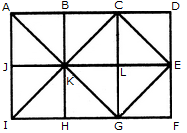
The squares composed of two components each are ABKJ, BCLK, CDEL, LEFG, KLGH and JKHI i.e.6 in number.
There is only one square i.e. CEGK composed of four components.
The squares composed of eight components each are ACGI and BDFH i.e. 2 in number.
There are 6 + 1 + 2 = 9 squares in the figure.
दिइएको चित्रमा वर्गको संख्या गणना गर्नुहोस्।
Explanation:
The figure may be labelled as shown.

The simplest squares are BCNM, CDON, PQIJ and QRHI i.e. 4 in number.
The squares composed of two components each are MNTS, NOUT, STQP and TURQ i.e. 4 in number.
The squares composed of five components each are ACTL, CEFT, TFGI and LTIK i.e. 4 in number.
The squares composed of six components each are BDUS and SUHJ i.e. 2 in number.
There is only one square i.e. MORP composed of eight components.
There is only one square i.e. AEGK composed of twenty components.
Total number of squares in the figure = 4 + 4 + 4 + 2+1 + 1 = 16.
दिइएको चित्रमा आयतहरूको (rectangles) संख्या गणना गर्नुहोस्।

Explanation:
The figure may be labeled as shown.

The simplest rectangles are ABJI, BCKJ, IJFG and JKEF i.e. 4 in number.
The rectangles composed of two components each are ACKI, BCEF, IKEG and ABFG i.e. 4 in number.
The only rectangle composed of four components is ACEG.
Thus, there are 4 + 4 + 1 = 9 rectangles in the given figure.
दिइएको चित्रमा आयतहरूको (rectangles) संख्या गणना गर्नुहोस्।
Explanation:
The figure may be labeled as shown.
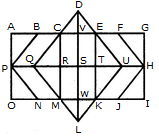
Rectangles:
The simplest rectangles are CVSR, VETS, RSWM and STKW i.e. 4 in number.
The rectangles composed of two components each are CETR, VEKW, RTKM and CVWM i.e. 4 in number.
The rectangles composed of three components each are ACRP, PRMO, EGHT and THIK i.e. 4 in number.
The rectangles composed of four components each are CEKM, AVSP,PSWO, VGHS and SHIW i.e. 5 in number.
The rectangles composed of five components each are AETP, PTKO, CGHR and RHIM i.e. 4 in number.
The rectangles composed of six components each are ACMO and EGIK i.e. 2 in number.
The rectangles composed of eight components each are AGHP, PHIO, AVWO and VGIW i.e. 4 in number.
The rectangles composed of ten components each are AEKO and CGIM i.e. 2 in number.
AGIO is the only rectangle having sixteen components.
Total number of rectangles in the given figure
= 4 + 4 + 4 + 5 + 4 + 2 + 4 + 2 + 1 = 30.
दिइएको चित्रमा आयतहरूको (rectangles) संख्या गणना गर्नुहोस्।
Explanation:
The figure may be labeled as shown.

The simplest rectangles are ABQP, PQNO, BCDN, NDEM, MEFL, LFJK, FGHR and RHIJ i.e. 8 in number.
The rectangles composed of two components each are ABNO, BCEM, NDFL, MEJK and FGIJ i.e. 5 in number.
The rectangles composed of three components each are ACDO, BCFL, NDJK and LGIK i.e. 4 in number.
There is only one rectangle i.e. BCJK composed of four components.
Total number of rectangles in the figure = 8 + 5 + 4 + 1 = 18.
दिइएको चित्रमा चतुर्भुजहरूको संख्या पत्ता लगाउनुहोस्।
Explanation:
The figure may be labeled as shown.

The quadrilaterals in the figure are ABCD, ABDE, ABDF, ABDH, CDHA, CDEA, CDFA, DEAG, DEFA, FAGD and AGDH.
The number of quadrilaterals in the figure is 11.
दिइएको चित्रमा वर्गको संख्या गणना गर्नुहोस्।
Explanation:
The figure may be labeled as shown.
The squares composed of two components each are BNQM, CORN, DPSO, MQTL, NRUQ, OSVR, PFWS, QUJT, RVIU and SWHV i.e. 10 in number.
The squares composed of four components each are ABQL, BCRQ, CDSR, DEFS, LQJK, QRIJ, RSHI and SFGH i.e. 8 in number.
The squares composed of eight components each are BRJL, CSIQ and DFHR i.e. 3 in number.
The squares composed of sixteen components each are ACIK, BDHJ and CEGI i.e. 3 in number.
Thus, there are 10 + 8 + 3 + 3 = 24 squares in the figure.