दिइएको चित्रमा सीधा रेखा र त्रिभुजको संख्या पत्ता लगाउनुहोस्।
Explanation:
The figure may be labeled as shown.

The Horizontal lines are DF and BC i.e. 2 in number.
The Vertical lines are DG, AH and FI i.e. 3 in number.
The Slanting lines are AB, AC, BF and DC i.e. 4 in number.
Thus, there are 2 + 3 + 4 = 9 straight lines in the figure.
Now, we shall count the number of triangles in the figure.
The simplest triangles are ADE, AEF, DEK, EFK, DJK, FLK, DJB, FLC, BJG and LIC i.e. 10 in number.
The triangles composed of two components each are ADF, AFK, DFK, ADK, DKB, FCK, BKH, KHC, DGB and FIC i.e. 10 in number.
The triangles composed of three components each are DFJ and DFL i.e. 2 in number.
The triangles composed of four components each are ABK, ACK, BFI, CDG, DFB, DFC and BKC i.e. 7 in number.
The triangles composed of six components each are ABH, ACH, ABF, ACD, BFC and CDB i.e. 6 in number.
There is only one triangle i.e. ABC composed of twelve components.
There are 10 + 10 + 2 + 7 + 6+ 1 = 36 triangles in the figure.
What is the minimum number of colors required to fill the spaces in the given diagram without any two adjacent spaces having the same color?
Explanation:
The figure may be labelled as shown.

The spaces P, Q and R have to be shaded by three different colours definitely (since each of these three spaces lies adjacent to the other two).
Now, in order that no two adjacent spaces be shaded by the same colour, the spaces T, U and S must be shaded with the colours of the spaces P, Q and R respectively.
Also the spaces X, V and W must be shaded with the colours of the spaces S, T and U respectively i.e. with the colours of the spaces R, P and Q respectively. Thus, minimum three colours are required.
दिइएको चित्रमा त्रिभुज र वर्गको संख्या पत्ता लगाउनुहोस् ।
Explanation:
The figure may be labeled as shown.
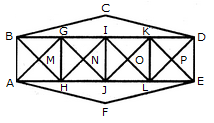
Triangles:
The simplest triangles are BGM, GHM, HAM, ABM, GIN, UN, JHN, HGN, IKO, KLO, LJO, JIO, KDP, DEP, ELP, LKP, BCD and AFE i.e. 18 in number.
The triangles are composed of two components each are ABG, BGH, GHA, HAB, HGI, GIJ, IJH, JHG, JIK, IKL, KLJ, LJI, LKD, KDE, DEL and ELK i.e. 16 in number.
The triangles are composed of four components each are BHI, GJK, ILD, AGJ, HIL and JKE i.e. 6 in number.
Total number of triangles in the figure = 18 +16 + 6 = 40.
Squares :
The squares are composed of two components each are MGNH, NIOJ and OKPL i.e. 3 in number.
The squares are composed of four components each are BGHA, GIJH, IKLJ and KDEL i.e. 4 in number.
Total number of squares in the figure = 3 + 4 = 7.
दिइएको चित्रमा त्रिभुज र वर्गको संख्या पत्ता लगाउनुहोस् ।
Explanation:
The figure may be labeled as shown.

Triangles:
The simplest triangles are JBO, BKO, KDO, DFO, FGO, GHO, HIO, IJO, ABJ, BCK, CKD and DEF i.e.12 in number.
The triangles composed of two components each are IBO, BDO, DGO, GIO, ABO, CDO, CBO, CBD and DEO i.e. 9 in number.
The triangles composed of four components each are IBD, BDG, DGI, GIB, ACO and COE i.e. 6 in number.
There is only one. triangle i.e. ACE composed of eight components.
Thus, there are 12 + 9 + 6 + 1 = 28 triangles in the given figure.
Squares:
The squares composed of two components each are BKOJ, KDFO, OFGH and JOHI i.e. 4 in number.
There is only one square i.e. CDOB composed of four components.
There is only one square i.e. BDGI composed of eight components.
Thus, there are 4 + 1 + 1 = 6 squares in the given figure.
What is the minimum number of different colours required to paint the given figure such that no two adjacent regions have the same colour?
Explanation:
The figure may be labelled as shown.

The regions A, C, E and G can have the same colour say colour 1.
The regions B, D, F and H can have the same colour (but different from colour 1) say colour 2.
The region 1 lies adjacent to each one of the regions A, B, C, D, E, F, G and H and therefore it should have a different colour say colour 3.
The regions J, L and N can have the same colour (different from colour 3) say colour 1.
The regions K, M and O can have the same colour (different fromthe colours 1 and 3). Thus, these regions will have colour 2.
The region P cannot have any of the colours 1 and 2 as it lies adjacent to each one of the regions J, K, L, M, N and O and so it will have colour 3.
The region Q can have any of the colours 1 or 2.
Minimum number of colours required is 3.
दिइएको चित्रमा त्रिभुज र वर्गको संख्या पत्ता लगाउनुहोस् ।
Explanation:
The figure may be labeled as shown.

Triangles :
The, simplest triangles are ABI, BGI, GHI, HAI, BCJ, CFJ, FGJ, GBJ, CDK, DEK, EFK and FCK i.e. 12 in number.
The triangles composed of two components each are ABG, BGH, GHA, HAB, BCF, CFG, FGB, GBC, CDE, DEF, EFC and FGD i.e. 12 in number.
The triangles composed of four components each are AGC, BFD, HBF and GCE i.e.4 in number.
Thus, there are 12 + 12 + 4 = 28 triangles in the given figure.
Squares :
The squares composed of two components each are BJGI and CKFJ i.e. 2 in number.
The squares composed of four components each are ABGH, BCFG and CDEF i.e. 3 in number.
Total number of squares in the figure = 2 + 3 = 5.
दिइएको चित्रमा समानान्तर चतुर्भुज( Parallelogram) को संख्या पत्ता लगाउनुहोस् ।
Explanation:
The figure may be labeled as shown.

The simplest ||gms are ABFE, BCGF, CDHG, EFJI, FGKJ and GHLK. These are 6 in number.
The parallelograms composed of two components each are ACGE, BDHF, EGKI, FHLJ, ABJI, BCKJ and CDLK. Thus, there are 7 such parallelograms.
The parallelograms composed of three components each are ADHE and EHLI i.e. 2 in number.
The parallelograms composed of four components each are ACKI and BDLJ i.e. 2 in number
There is only one parallelogram composed of six components, namely ADLI.
Thus, there are 6 + 7 + 2 + 2 + 1 = 18 parallelograms in the figure.
दिइएको बृतका केन्द्र (Center) लाई ठाडो र तेर्सो गरी एक आपसमा जोड्ने हो भने कति वटा वर्ग बन्न सक्छ ?
Explanation:
The figure may be labelled as shown.

We shall join the centres of all the circles by horizontal and vertical lines and then label the resulting figure as shown.
The simplest squares are ABED, BCFE, DEHG, EFIH, GHKJ and HILK i.e. 6 in number.
The squares composed of four simple squares are ACIG and DFLJ i.e. 2 in number.
Thus, 6 + 2 = 8 squares will be formed.
दिइएको चित्रमा त्रिभुज र वर्गको संख्या पत्ता लगाउनुहोस् ।
Explanation:
The figure may be labelled as shown.

Triangles :
The simplest triangles are BPN, PNE, ABM, EFG, MLK, GHI, QRO, RSO, STO and QTO i.e. 10 in number.
The triangles composed of two components each are BPE, TQR, QRS, RST and STQ i.e. 5 in number.
The triangles composed of three components each are MPO and GPO i.e. 2 in number.
The triangles composed of six components each are LPJ, HPJ and MPG i.e. 3 in number.
There is only one triangle LPH composed of twelve components.
Total number of triangles in the figure = 10 + 5 - 2 + 3 + 1 = 21.
Squares :
The squares composed of two components each are KJOM and JIGQ i.e. 2 in number.
The squares composed of three components each are ANOM, NFGO and CDEB i.e.3 in number.
There is only one square i.e. QRST composed of four components.
There is only one square i.e. AFIK composed of ten components.
Total number of squares in the figure = 2 + 3 + 1 + 1 = 7.
तलको चित्रमा कतिवटा त्रिभुज र समानान्तरभुजहरू ( Parallelograms)छन्?
Explanation:
The figure may be labelled as shown.
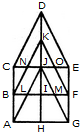
Triangles:
The simplest triangles are KJN, KJO, CNB, OEF, JIL, JIM, BLA and MFG i.e. 8 in number.
The triangles composed of two components each are CDJ, EDJ, NKO, JLM, JAH and JGH i.e. 6 in number.
The triangles composed of three components each are BKI, FKI, CJA and EJG i.e. 4 in number.
The triangles composed of four components each are CDE and AJG i.e. 2 in number.
The only triangle composed of six components is BKF.
Thus, there are 8 + 6 + 4 + 2 + 1 = 21 triangles in the given figure.
Parallelograms :
The simplest parallelograms are NJLB and JOFM i.e. 2 in number.
The parallelograms composed of two components each are CDKB, DEFK, BIHA and IFGH i.e.4 in number.
The parallelograms composed of three components each are BKJA, KFGJ, CJIB and JEFI i.e.4 in number.
There is only one parallelogram i.e. BFGA composed of four components.
The parallelograms composed of five components each are CDJA, DEGJ, CJHA and JEGH i.e.4 in number.
The only parallelogram composed of six components is CEFB.
The only parallelogram composed of ten components is CEGA.
Thus, there are 2 + 4 + 4 + 1 + 4+ 1 + 1 = 17 parallelograms in the given figure.
(Here note that the squares and rectangles are also counted amongst the parallelograms).
दिइएको चित्रमा वर्गहरूको संख्या गणना गर्नुहोस्।
Explanation:
The figure may be labelled as shown.

The squares composed of two components each are BJMI, CKMJ, DLMK and AIML i.e. 4 in number.
The squares composed of three components each are EBMA, BFCM, MCGD and AMDH i.e. 4 in number.
The squares composed of four components each are VWBA, XYCB, ZA1DC and B1C1AD i.e. 4 in number.
The squares composed of seven components each are NOJL, PQKI, RSLJ and TUIK i.e. 4 in number.
There is only one square i.e. ABCD composed of eight components.
There is only one square i.e. EFGH composed of twelve components.
Total number of squares in the figure = 4 + 4 + 4 + 4 + 1 + 1 = 18.
दिइएको चित्रमा समानान्तर चतुर्भुजको संख्या गणना गर्नुहोस्।
Explanation:
The figure may be labelled as shown.
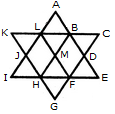
The simplest parallelograms are LMHJ and BDFM i.e. 2 in number. The parallelograms composed of two components each are ABML and MFGH i.e. 2 in number.
The parallelograms composed of three components each are LBHI, LBEF, BDGH, DFLA, BCFH, KLFH, A6HJ and LFGJ i.e. 8 in number.
The parallelograms composed of six components each are LCFI, KBEH and ADGJ i.e. 3 in number.
Total number of parallelograms in the figure = 2 + 2 + 8 + 3 = 15.
Count the number of convex pentagons in the adjoining figure.
Explanation:
A convex pentagon has no angles pointing inwards. More precisely, no internal angles can be more than 180°.
The figure may be labelled as shown.

The pentagons in the figure, are ABDFH, CDFHB, EFHBD, GHBDF, ACDFG, CEFHA, EGHBC, GABDE, BDEGH, DFGAB, FHACD and HBCEF. Clearly, these are 12 in number.
दिइएको चित्रमा आयतहरू (rectangles) को संख्या गणना गर्नुहोस्।

Explanation:
The figure may be labelled as shown.
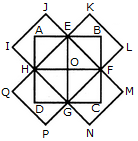
The rectangles composed of two components each are HIJE, EKJ,F, FMNG, GPQH, AEOH, EBFO, OFCG and HOGD i.e. 8 in number.
The rectangles composed of four components each are ABFH, BCGE, CDHF, DAEG and EFGH i.e. 5 in number.
The rectangles composed of six components each are IJFG, KLGH, MNHE and PQEF i.e. 4 in number.
The rectangles composed of eight components each are IJMN, KLPQ and ABCD i.e. 3 in number.
Thus, there are 8 + 5 + 4 + 3 = 20 rectangles in the given figure.
(Here note that the squares are also counted amongst rectangles)
दिइएको चित्रमा त्रिभुज र वर्गको संख्या पत्ता लगाउनुहोस् ।
Explanation:
The figure may be labelled as shown.
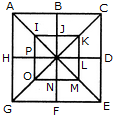
Triangles :
The simplest triangles are IJQ, JKQ, KLQ, LMQ, MNQ, NOQ, OPQ and PIQ i.e. 8 in number. The triangles composed of two components each are ABQ, BCQ, CDQ, DEQ, EFQ, FGQ, GHQ, HAQ, IKQ, KMQ, MOQ and OIQ i.e. 12 in number.
The triangles composed of four components each are ACQ, CEQ, EGQ, GAQ, IKM, KMO, MOI and OIK i.e. 8 in number.
The triangles composed of eight components each are ACE, CEG, EGA and GAC i.e. 4 in number.
Total number of triangles in the figure = 8 + 12 + 8 + 4 = 32.
Squares :
The squares composed of two components each are IJQP, JKLQ, QLMN and PQNO i.e. 4 in number.
The squares composed of four components each are ABQH, BCDQ, QDEF and HQFG i.e. 4 in number.
There is only one square i.e. IKMO composed of eight components.
There is only one square i.e. ACEG composed of sixteen components.
Thus, there are 4 + 4 + 1 + 1= 10 squares in the given figure.
दिइएको चित्रमा समानान्तर चतुर्भुज (parallelogram) को संख्या गणना गर्नुहोस्।

Explanation:
The figure may be labelled as shown.
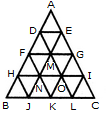
The parallelograms composed of two components each are ADME, DFNM, EMOG, FHJN, MNKO, GOLI, HBJN, NJKO, OKLI, FHNM, MNOG, DFME, HJKN, NKLO, OLCI, FNOM, MOIG and DMGE. i.e. 18 in number.
The parallelograms composed of four components each are HOKB, NILJ, FGOH, HOLJ, NICK, FGIN, FMJB, DENH, MGKJ, MGCL, DEIO, FMLK, AENF, AGOD, DMJH, DOKF, EILM and EGKN i.e. 18 in number.
The parallelograms composed of six components each are AEJH, DAIL, DECL, DEJB, HILB and HICJ i.e. 6 in number.
The parallelograms composed of eight components each are FGKB, FGCK and AGKF i.e. 3 in number.
Total number of parallelograms in the figure = 18 + 18 + 6 + 3 = 45.
दिइएको चित्रमा समानान्तर चतुर्भुज( Parallelogram) को संख्या पत्ता लगाउनुहोस् ।
Explanation:
The figure may be labelled as shown.
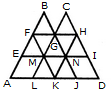
The simplest parallelograms are EMLA and NIDJ i.e. 2 in number.
The parallelograms composed of two components each are BFMG, CGNH, GMKN, FGME, GHNM, MNKL, FGNM, GHIN and MNJK i.e. 9 in number.
The parallelograms composed of three components each are FGLA, ENKA, GHDJ and MIDK ie. 4 in number.
The parallelograms composed of four components each are FGJK, GHKL, FBNK, CHKM, EFHN and MFHI i.e. 6 in number.
The parallelograms composed of seven components each are FHKA and FHDK i.e. 2 in number.
Total number of parallelograms in the figure = 2 + 9 + 4 + 6 + 2 = 23.
दिइएको चित्रमा त्रिभुज र वर्गको संख्या पत्ता लगाउनुहोस् ।
Explanation:
The figure may be labelled as shown.

Triangles :
The simplest triangles are AEI, EOI, OHI, HAI, EBJ, BFJ, FOJ, OEJ, HOL, OGL, GDL, DHL, OFK, FCK, CGK and GOK i.e. 16 in number.
The triangles composed of two components each are HAE, AEO, EOH, OHA, OEB, EBF, BFO, FOE, DHO, HOG, OGD, GDH, GOF, OFC, FCG and CGO i.e. 16 in number.
The triangles composed of four components each are HEF, EFG, FGH, GHE, ABO, BGO, CDO and DAO i.e. 8 in number.
The triangles composed of eight components each are DAB, ABC, BCD and CDA i.e. 4 in number.
Total number of triangles in the figure = 16 + 16 + 8 + 4 = 44.
Squares :
The squares composed of two components are HIOL, IEJO, JFKO and KGLO i.e. 4 in number.
The squares composed of four components are AEOH, EBFO, OFGC and HOGD i.e.4 in number.
There is only one square EFGH which is composed of eight components.
There is only one square ABCD which is composed of sixteen components.
Total number of squares in the figure = 4 + 4 + 1 + 1 = 10.
दिइएको चित्रमा कति वटा वृत (Circle) रहेका छन?
Explanation:
The figure may be labelled as shown.

There are 13 circles in the given figure. This is clear from the adjoining figure in which the centres of all the circles in the given figure have been numbered from 1 to 13.