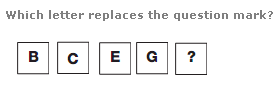
Explanation:
As you move down, the numerical value of the letters follows the sequence of Prime Numbers.
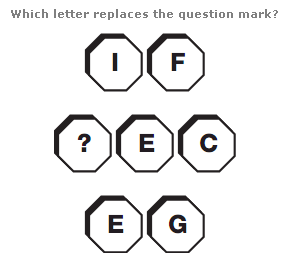
Explanation:
Writing each letter as its numerical value and working in rows, add the top 2 digit number to the bottom 2 digit number to give the 3 digit result in the centre.
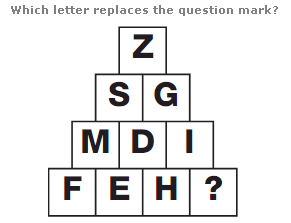
Explanation:
The numerical values of the letters in each row add up to 26 each time.

Explanation:
Working in rows, add together the numerical values of the left and right hand letters to give the numerical value of the central letter.

Explanation:
In each segment of the diagram are a pair of letters, one of which is the same distance from the start of the alphabet as the other is from the end.

Explanation:
The numerical values of the letters in opposite segments of the circle always add up to 17.

Explanation:
Starting at the top left and moving down, then right one column and up, etc in a snakes and ladders pattern, letters move through the alphabet 4 letters at a time.

Explanation:
In each row, add the numerical value of the left and right-hand letters together and write the letter with the reverse alphabetical value in the center.

Explanation:
Starting at F and moving anti-clockwise, letters move through the alphabet in steps of 2, 3, 4, 5 etc.

Explanation:
Starting at the top left circle, and moving right, then down one row and moving left, in a snakes and ladders pattern, letters move through the alphabet in steps of 2, 3, and 4, repeating this pattern all the way down.

Explanation:
Starting at the top left, and moving anti-clockwise around the figure, letters advance through the alphabet 5 letters at a time.

Explanation:
Using the numerical value of each letter, in each column, the value of the central letter equals the sum of the values of the top and bottom letters.

Explanation:
The alphabetical value of the letters in the left-hand column follows through the sequence of Prime Numbers, with the letters in the right-hand column representing the corresponding reverse alphabetical values.

Explanation:
Starting on the left, and moving downwards in columns from left to right, letters are written in alphabetical sequence, in steps of 4 letters at a time.

Explanation:
In each diagram, letters are written in sequence, starting in the top left circle and moving clockwise around the other 3 outer circles, in steps given by the numerical value of the central letter each time.

Explanation:
Starting on the left, and moving along the line to the right, letters follow the alphabetic sequence, in steps of 1,2,3, and then 4, before repeating the sequence.

Explanation:
Starting in the top left circle, and following a W pattern through the others, letters in corresponding segments of the circles follow the alphabetical sequence in steps of 4 letters.

Explanation:
Working from left to right, letters move forwards 7 places, then back 2. Repeat this sequence until the end.

Explanation:
In each row, the product of the left and right-hand numbers equals the sum of the numerical values of the three letters.
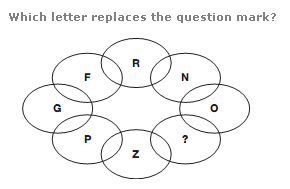
Explanation:
Start at the top and move down, taking single letters or pairs of letters that appear on the same horizontal line. The sum of the numerical values of the letters in each line increases by 2 as you go down, from 18 to 26.
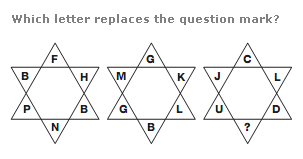
Explanation:
In each star shape, the sum of the numerical values of the letters bounded by one triangle is equal to that of the other triangle
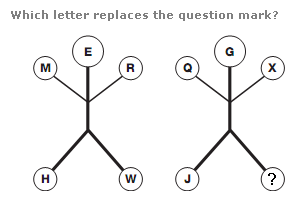
Explanation:
In each stick-man diagram, start on the left foot and move around the other limbs in a clockwise direction. The letters advance through the alphabet in steps given by the numerical value of the letter on the head of the diagram.
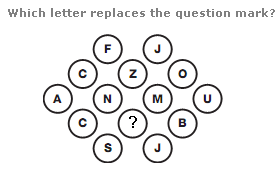
Explanation:
Start on the center-left of the diagram, and move in a clockwise spiral towards the center. Letters advance through the alphabet in steps of 2, 3, 4, etc.
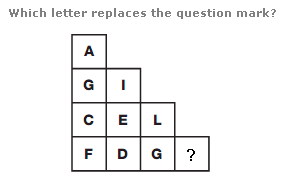
Explanation:
Working through the diagram in columns, left to right, The sum of the numerical values of the letters in each column follows the sequence 17, 18, 19, and 20.
Explanation:
Read the diagram as a whole grid of 4x4 squares. Starting on the bottom left square, move clockwise around the outside of the whole square, with letters written in sequence, skipping 4 letters at a time. Repeat this instruction for the small inner square.

Explanation:
Start on the far left of the diagram and move around it in a clockwise direction. Letters advance through the alphabet in steps of 8 then 9, repeating this pattern all the way around.

Explanation:
Working through the diagram in rows, from top to bottom, the sum of the numerical values of the letters in each row follows the sequence 15, 20, 25, 30, 35

Explanation:
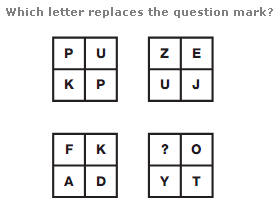
Letters are arranged in each square in alphabetical order, skipping 5 letters at a time. The letter bounded by the central square carries on this sequence but uses the reverse alphabetical value.
Explanation:
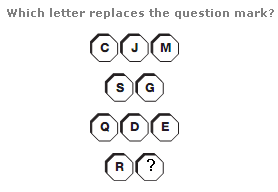
In each row of the diagram, the numerical values of the letters add up to 26.
Explanation:
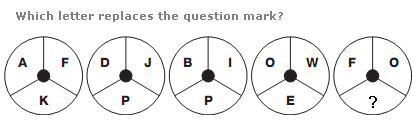
In each circle, start with the top left segment, and move clockwise around the other segments. The value of each letter increases by 5 for the first circle, 6 for the next, then 7, 8, and 9.
Explanation:
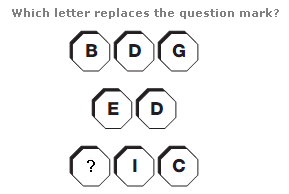
Converting each letter to its numerical value, the diagram represents a subtraction sum: 247 - 54 = 193.

Explanation:
Starting on the top left, and moving in an anti-clockwise spiral towards the center, letters advance through the alphabet by 3 letters at a time.

Explanation:
Looking at the diagram in columns, letters in the first column are written with 2 straight lines, in the second column they contain 3 straight lines, and letters in the right-hand column are written with 4 straight lines.

Explanation:
Following lines of circles across all 3 diagrams, letters in the top line follow the alphabetic sequence, in steps of 4 letters at a time. Letters in the central line advance 5 letters, and in the bottom line, 6 letters.

Explanation:
Moving from left to right, letters move through the alphabet in sequence, skipping 12 letters, then 11, 10, 9, 8, etc.

Explanation:
The numerical values of the letters in each circle add up to 20.

Explanation:
Taking the numerical value of each letter, they follow the sequence of Prime Numbers.

Explanation:
Starting with the A on the left-hand side, move around the shape in a clockwise spiral towards the center. Letters advance through the alphabet in steps of 4, 5 then 6, repeating this pattern all the way around.

Explanation:
Starting with A and C, as you move clockwise, the numerical value of the next letter equals the sum of the preceding two letters.

Explanation:
As you move down, letters appear in alphabetical order, skipping those letters only written with straight lines.

Explanation:
Starting at the top left, and moving to the right, then down one row and to the left etc. in a snakes and ladders pattern, letters advance through the alphabet by 5 steps, then back 2, repeating this pattern for the rest of the diagram.

Explanation:
Taking pairs of letters in the inner and outer segments of each eighth of the diagram, the numerical values always add up to 20.

Explanation:
Working in columns, add together the numerical values of the first and second letters, and put the letter with the reverse alphabetical value of this sum in the bottom space.

Explanation:
Starting with the G, move clockwise around the circle, in steps of 3 letters, then 4, 5, 6 and 7.

Explanation:
As you move down, letters are written in alphabetical order, skipping any letters written with curved lines.

Explanation:
Starting with the top segment of the top left square and moving clockwise around the other 3 squares, letters move through the alphabet in steps of 2, with the positions moving one place clockwise each time. Letters in the next segment of the top left square follow the same pattern, in steps of 3 letters etc.

Explanation:
Starting with the bottom right letter and moving in a clockwise spiral around the diagram towards the centre, letters advance through the alphabet six letters at a time.

Explanation:
The 4 diagrams as a whole contain 2 sequences of letters. The first starts at the top of the top left hand diamond, and goes vertically downwards, then up to the top of the top right hand diamond and down again. Letters in this sequence are written in alphabetical order, in steps of 4 letters at a time. The second sequence starts on the left hand segment of the upper left diamond and moves in horizontal lines from left to right, top row then bottom row, with the letters written in alphabetical order in steps of 5 letters at a time.
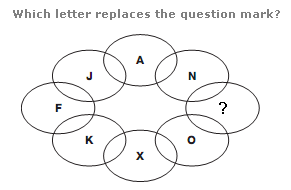
Explanation:
Join pairs of letters at opposite sides of the diagram, with lines which run through the centre. The sum of the numerical values of the pairs of letters is always 25.
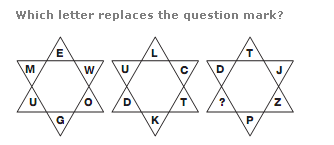
Explanation:
In each star, start at the bottom and move anti-clockwise around the points. Letters follow the alphabetic sequence, in steps of 8 letters, for the left hand circle, 9 for the central one and 10 for the right hand circle.

Explanation:
Working in columns from top to bottom, left to right, letters are written in alpha- betic sequence, in steps of 3 letters, then 4, then 5 etc.

Explanation:
Starting with the letters in the top left square, and moving around the other squares in a clockwise spiral towards the centre, letters advance through the alphabet in steps of 4 letters at a time, with the relative positions of each letter moving 1/4 turn clockwise at each step.

Explanation:
Start with the top left square and move clockwise around the others. The sum of the numerical values of the letters in each square follows the sequence 20, 25, 30 and 35.

Explanation:
Start with the top left circle, and move in horizontal lines from left to right, top to bottom, across all 4 shapes. Letters are written in alphabetical order, in steps of 5 letters at a time.

Explanation:
Starting with B and moving clockwise, letters advance through the alphabet in steps of 2, then 4, 6, 8 and 10.

Explanation:
Convert each letter into its numerical value, and read each row as a 3 digit number. Rows follow the sequence of Square Numbers from 15 to 17.

Explanation:
Starting with the top left outer segment and moving clockwise, letters advance through the alphabet in steps of 4, then 5, 6, 7 etc. The letters in the inner segments follow the same pattern, but move anti-clockwise.

Explanation:
Starting at the top left and working anti-clockwise towards the centre in a spiral, letters advance through the alphabet in steps of 8 at a time.

Explanation:
Taking pairs of letters in adjacent segments, their numerical values always add up to 10.

Explanation:
Each hexagon is filled with the letter of the alphabet you find one place after the vowels.

Explanation:
Adding 1 to the numerical values of each letter gives the sequence of Prime Numbers.

Explanation:
Starting with the B on the lower right of the triangle, and following the diagram round in a clockwise direction, letters move through the alphabet in steps of 5.

Explanation:
In each column of the diagram, the sum of the numerical values of the letters is always 25

Explanation:
In each group of 3 squares, starting on the upper left and moving clockwise around the other 2 squares, letters follow the alphabetic sequence in steps of 6 for the left hand diagram, 7 for the upper middle, 8 for the right hand diagram and 9 for the lower one.

Explanation:
Add 6 to the numerical value of each of the larger letters, and write the letter with this value in the smaller square diagonally opposite.

Explanation:
Converting each letter to its numerical value and reading each line as a 2 digit number, the numbers follow the sequence of multiples of 6, from 36 to 54.

Explanation:
Starting with the left hand circle in the top row, add 4 to the numerical value of each letter and write the letter with this value in the corresponding segment of the lower left circle. Continue this pattern, adding 5 to the letter values in the central circle, and 6 in the right hand circle.

Explanation:
Convert each letter to it’s numerical value, and read horizontal lines as 2 or 3 digit numbers. Add the top 3 digit number to the 2 digit number below to give 200, repeat this pattern for the 3 and 2 digit numbers underneath.

Explanation:
Starting at the top left of the diagram, and moving around it in a Z shape, letters follow the alphabetic sequence, in steps of 6 letters at a time.

Explanation:
Working in rows, the numerical value of the letter in the right hand column equals the sum of the numerical values of the letters in the left and central columns.

Explanation:
Starting with the top left segment of each circle, and moving clockwise, letters follow the alphabetic sequence, in steps of 3 letters for the top circle, 4 letters for the left hand circle, and 5 letters for the bottom circle.

Explanation:

Explanation:
Start at the top of the diagram, and work through each row from left to right. Letters move through the alphabet, In steps of 3 letters, then 4, 5 and 6, repeating this sequence

Explanation:
In each diagram, starting on the top left and moving clockwise in a spiral towards the centre, letters increase in value by 3 for the left hand diagram, 4 for the middle, and 5 for the right hand diagram.

Explanation:
Starting with the B in the top left, and moving left to right across the diagram in horizontal lines, letters advance through the alphabet in steps of 6 letters at a time.

Explanation:
In each square, start with the left hand segment, and move clockwise around the others. Letters are written in alphabetical order in steps of 10 for the top left square, 11 for the top right, 12 for the lower left and 13 for the lower right.

Explanation:
Treat each star as 2 intersecting triangles, and start on the top or the left of each triangle in each star and move clockwise around it. Letters are written in alphabetical order in steps of 6 for the left hand star, 7 for the central one and 8 for the right hand star.

Explanation:
Two sequences are used in these five grids, both only using the lines containing three letters. Firstly, move along the horizontal lines from top left to bottom right in steps of four, starting with the A. Secondly, move down the vertical lines in steps of six, starting with the E. Whenever two numbers cross add the numerical values together and put the solution in the middle of each cross.

Explanation:
The sum of the letters in the three adjacent circles on each side of the diagram is always 30.

Explanation:
The diagram contains 3 sets of 4 letters - one set of outer corner letters, one set of inner corner letters, and one set of letters on each side of the square. The numerical values of the letters in each set add up to 40.

Explanation:
In each diagram, the central letter falls midway between the left and right hand letters, and the top and bottom letters.

Explanation:
Start on the upper left of each diagram, and move to the right, then down the last 2 boxes in the centre. Letters are written in alphabetical order, in steps of 5 for the left hand diagram, 6 for the next, then 7, then 8.

Explanation:
Split the circle into 4 quarters, horizontally and vertically, with 2 segments each. Starting with the top left segment, the sum of the numerical values of the letters in the 2 segments equals 15. The sum of the next pair of segments clockwise equals 16, then 17, then 18.

Explanation:
Taking each pair of letters in each row, the numerical value of one letter equals the inverse numerical value of the other letter.

Explanation:
Start at the top left, and work through the diagram in a Z shape, letters move through the alphabet in steps of 6, then 7, then 8 etc.

Explanation:
Start on the top left and move down, then right one space and up etc in a snakes and ladders pattern. Letters advance through the alphabet in steps of 5.

Explanation:
Start with the letters in the left hand circle. Subtract 3 from the numerical values of each letter, and put the letter with this value in the corresponding segments of the upper circle. Repeat this pattern, adding 3 to the numerical values of the letters, and putting the results in corresponding segments of the lower circle.

Explanation:
Moving from left to right, top to bottom letters follow alphabetical order, skipping any letters written with curved lines.

Explanation:
Working from top to bottom, the numerical values of the letters follow the sequence of Prime Numbers, adding 1, then 2, then 3 etc

Explanation:
Start at the top of the diagram and work in rows, from left to right, top to bottom. Letters move through the alphabet in steps of 4, 5, 6, 7, 8, 9 and 10, before repeating this sequence.

Explanation:
Starting with the top letter in each star, and moving clockwise around the others, letters advance through the alphabet in steps of 8 for the left hand star, 9 for the central star, and 10 for the right hand star.

Explanation:

Explanation:
The numerical values of the letters in opposite segments of the circle add up to 16 each time.

Explanation:
Starting in the bottom left corner of the diagram, and moving clockwise, letters follow in alphabetic order, skipping 1 letter, then 2, then 3 etc.

Explanation:
Starting with the A in the top left segment of the circle, and moving clockwise, letters follow a modified alphabetic sequence. To make the sequence, write the alphabet, removing all letters written with any curved lines, then take alternate letters from this sequence.

Explanation:
From left to right, the numerical value of the letters represents the sequence of multiples of 5, from 5 to 25.

Explanation:
Working downwards, add the numerical values of the first two letters together, and put the letter with this value in the next box down. Continue in this way down the diagram.

Explanation:
Starting at the top left and moving in a Z shape around the diagram, the numerical value of the letters increases by 6, then 7, then 8 etc.

Explanation:
Add together the numerical values of the letters which appear in the outer segments, and put the letter with this value in the inner segment, one place clockwise.

Explanation:
Start on the left hand of the diagram, and move clockwise. Letters are written in alphabetical order, in steps of 10 letters at a time.

Explanation:
Start on the left of the diagram, and work in columns, top to bottom, from left to right. Letters are written in sequence, in steps of 2, then 4, then 6, then 8, before repeating this pattern.

Explanation:
In each row, take the reverse alphabetical value of the left hand letter and the alphabetical value of the right hand letter and calculate the difference, putting this result in the central square.

Explanation:
Taking pairs of letters at opposite sides of the diagram, the sum of their numerical values equals 21 each time.

Explanation:
Starting with the top left triangle, and moving clockwise around the other 2, letters advance through the alphabet in steps of 4, 5 and 6, with their relative positions moving 1 place clockwise around each triangle.

Explanation:
Starting on the top left, and moving to the right, then down one row and to the left etc. in a snakes and ladders pattern, letters advance through the alphabet in steps of 5, then 2, then 5 etc.

Explanation:
| In each row, the numerical value of the central letter equals the sum of the numerical values of the left and right hand letters. |

Explanation:
Starting with the top left segment and moving clockwise, letters advance through the alphabet in steps of 4, then 5, then 6 etc.

Explanation:
Working from top to bottom, letters appear in alphabetical order, skipping any letters written with only straight lines.

Explanation:
Starting with the top left square, and moving clockwise around the other squares, the numerical values of each letter increase by 2, with their relative positions in each square rotating 1 place clockwise at each turn.

Explanation:
Starting with the letters in the top row, and following straight lines through the middle circle, subtract the numerical value of the middle letter (G) and write the letter with the corresponding numerical value in the lower circle.

Explanation:
Starting with the bottom left letter and moving in a clockwise spiral towards the centre, letters advance through the alphabet in steps of 4, 5, 6 etc.

Explanation:
Starting with the bottom row and moving up, one row at a time, the sum of the numerical values of the letters starts at 26 for the bottom row, then 24, 22 and 20 as you move up.

Explanation:
The sum of the numerical values of pairs of letters, opposite each other in the diagram, is always 20 (the numerical value of the central letter).

Explanation:
Start with the D on the outer left of the diagram, and move clockwise around the outer segments, then start on the N anti-clockwise around the inner segments. Letters advance through the alphabet in steps of 3, then 4, 5, and 6, repeating this sequence.

Explanation:
In each circle, the reverse alphabetical value of the lower letter equals the sum of the alphabetical values of the top 2 letters.

Explanation:
The sum of the numerical values of letters in opposite segments of the circle is always 22.

Explanation:
Starting at the top and moving down, the sum of the numerical values of the letters in each oval follows the sequence 20, 22, 24 etc

Explanation:
Start with the top left square, and move clockwise around the others. The sum of the numerical values of the letters in each square equals 20 for the top left, 25 for the top right, 30 for the bottom right and 35 for the bottom left.

Explanation:
Start on the bottom left and move up to the top, then to the right one space and down to the bottom. Letters follow the alphabetic sequence alternately in steps of 6, then 8. Starting on the bottom right and moving up to the top, then left one space and down to the bottom, letters in this half follow the same pattern.

Explanation:
Starting at the top left hand of every diagram, move around the outer circles in an anti-clockwise direction. Letters are written in alphabetic sequence, in steps given by the numerical value of the central letter.

Explanation:
Starting on the left, and moving to the right, letters are written in alphabetical order, moving forward 8 places, then back 2, then forward 7 places and back 3. Repeat this sequence to the end of the line.

Explanation:
Start with A on the left hand side, and move in a clockwise spiral around the diagram. Letters advance through the alphabet in steps of 6.

Explanation:
Starting on the left and moving right, letters are written in alphabetical order, using every other letter written with only straight lines.

Explanation:
Start with the outer top left segment, and move around the circle clockwise, then move in to the middle segments and move anticlockwise. Following this path, letters advance through the alphabet in steps of 7 letters at a time.

Explanation:
In each shape, start at the bottom left and move up, then diagonally down to the right, and finally up the right hand column, in an N shape. Letters move through the alphabet in steps of 4, 5, 6, 7, 8, and 9.

Explanation:
Start at the top, and work left to right in rows, top to bottom. Letters advance through the alphabet in steps of 10, 11, 12, 13 etc.

Explanation:
Start in the bottom left hand corner of the diagram and, moving around the whole diagram, work in a clockwise direction, around the outer squares. Letters are written in alphabetical order, in steps of 7 letters at a time. For the single square still remaining in each group of 4, add the numerical values of the other 3 letters in the square together to give a 2 digit number, and add these separate digits together, and put the letter with this numerical value in the central square.

Explanation:
Start at the top, and move diagonally down and to the right. Letters advance through the alphabet in steps of 5 then 6. Continue this pattern, starting with the next circle down on the left etc.

Explanation:
Start with the letter in the top left, and move clockwise around the square. The numerical value of the letters follows the sequence of prime numbers, from 2 to 19.

Explanation:

Explanation:
Start on the top left of the left hand diagram, and move in horizontal lines, from left to right, top to bottom, across all 4 diagrams as a whole. Letters advance through the alphabet in steps of 7, then back 2, repeating this sequence all the way around.

Explanation:
Starting with the G and moving clockwise, letters advance through the alphabet in steps of 3 letters, then 4, then 5 etc.

Explanation:
Starting on the top left of each outer square, and moving clockwise around the corners of the squares, letters advance through the alphabet in steps of 4 for the upper left square, 5 for the upper right, 6 for the lower right and 7 for the lower left. Additionally, the letters bounded by the central square take the inverse alphabetical value of the original letter.

Explanation:
Start on the top left, and work through the diagram in columns, from left to right. The sum of the numerical values of the letters in each column starts at 20, then increases by 1 as you move one column to the right.

Explanation:
Starting at the top left of the diagram, and moving in a Z shape, letters advance through the alphabet in steps of 5.

Explanation:
Start with the top point of each star, and move clockwise around the other points. Letters advance through the alphabet in steps of 5 for the left hand star, 6 for the central star, and 7 for the right hand star.

Explanation:
Working in columns, add the numerical value of the top and middle letters together to give the numerical value of the lower letter.

Explanation:
Start with the letters in the top left circle, and move around the other circles in a clockwise direction. Letters advance through the alphabet 6 letters at a time, with the relative positions of each letter moving one place clockwise each time.

Explanation:
Start at the top to the left hand triangle, and work across the whole diagram in horizontal lines from left to right, top to bottom. Letters are written in alphabetic sequence, skipping 3 letters each time.

Explanation:
In each star, start with the letter in the lower left hand point, and move around the other points in a clockwise direction. Letters advance through the alphabet in steps of 6 for the left hand star, 7 for the one in the centre, and 8 for the right hand star.

Explanation:
Start on the left, and move to the right. Letters advance through the alphabet in steps of 2, then 3, then 4 etc.

Explanation:
In each triangle, start with the bottom left letter, and move clockwise around the other points. Letters advance through the alphabet in steps given by the numerical value of the letter at the centre of the triangle.

Explanation:
Start on the left and work to the right. There are two alternating sequences of letters - one starts with A and moves through the alphabet 5 letters at a time. The other starts on H and moves through the alphabet 3 letters at a time.

Explanation:
Start at the top, and work through the triangle in horizontal rows, from top to bottom, left to right. Letters move through the alphabet 5 letters at a time.

Explanation:
Start with the outer segment in the top left, and move anti-clockwise. Letters advance through the alphabet in steps of 6, then 7, then 8. Continue around the outer segments of the diagram, then move in an anti-clockwise direction around the inner segments.

Explanation:
Starting with the top two segments, the sum of the numerical values of letters in adjoining segments equals 20.

Explanation:
Start with the top segment of the top left square, and move directly downwards. Each group of 4 letters follows the alphabetic sequence, in steps of 5 letters at a time. Taking other straight lines vertically and horizontally through the diagram, letters follow the same pattern.

Explanation:
Starting with the top left letter, and moving clockwise around the others, letters advance through the alphabet in steps given by the numerical value of the central letter (6).

Explanation:
In each group of 3 boxes, calculate the difference in numerical values between the top two letters, and add 1 to give the value of the letter in the lower box.

Explanation:
Starting in the top left of the diagram, and working in columns, from top to bottom, letters follow the alphabetical sequence, advancing 2 letters, then 4, then 6, then 8 etc.

Explanation:
Start at the top of the diagram, and move clockwise. Letters appear in alphabetical order, in steps of 10 letters at a time.

Explanation:
In each diagram, add the numerical value of the upper right and left letters to the lower right and left letters, to give the letters in the centre of the columns. Calculate the difference between these middle letters to give the value of the letter right at the centre.

Explanation:
Start with the A in the bottom left corner, and move in a clockwise spiral around the diagram towards the centre. Letters are written in alphabetic order, in steps of 6 letters at a time.

Explanation:
Start with the top left grid and move around the others in a clockwise spiral towards the centre. Letters follow alphabetic sequences, skipping 1, 2, 3 and 4 letters at a time, with their relative positions in each grid rotating 1/4 turn clockwise each time

Explanation:
In each row, add together the numerical values of the pairs of letters to the left and right, then calculate their difference, putting the letter with this numerical value in the centre space.

Explanation:
Start on the left hand side, and move clockwise around the diagram. Letters advance through the alphabet 9 letters at a time.

Explanation:
Start on the top left of the diagram, and move from left to right, top row to bottom row. Letters advance through the alphabet in steps of 6, 7 then 8, before repeating this pattern.

Explanation:
Starting on the top left, and moving around the whole diagram in an anti- clockwise direction, outside then inside, letters advance through the alphabet 5 letters at a time.

Explanation:
Start at the top of the triangle and move anti-clockwise around it. Letters move through the alphabet in steps of 3, 4, 5, 6 etc.

Explanation:
Start with the H in the top left segment, and move clockwise around the shape, alternating between outer segment then inner segment. Letters advance through the alphabet 6 letters at a time.

Explanation:
Starting with H and moving anti-clockwise, letters advance through the alphabet in steps of 10, then 8, then 6 etc.

Explanation:
As you move down, add the number of straight lines in the first letter to the numerical value of that letter to give the next one down.

Explanation:
Start at the top left, and move around the diagram in a Z shape. The numerical value of the letters increases alternately by 6, then 3.

Explanation:
Convert each letter to its numerical value, and split the diagram into rows, reading each row as a 2 or 3 digit value. The value represented by the middle line of the diagram equals the sum of the upper value and lower value.

Explanation:
Working through the diagram in columns, from top to bottom, letters move through the alphabet in steps of 5 for the left hand column, 7 for the next one, then 9, then 11.

Explanation:
In each diagram, add the numerical values of the top 2 letters together, divide this by 2 and subtract 2 to give the numerical value of the lower letter.

Explanation:
The sum of the numerical values of the letters in each column of the diagram equals 29.

Explanation:
The sum of the numerical values of the letters in opposite segments of the circle equals 26.

Explanation:
Start with the letter J in the top left square, and move clockwise around the other squares. Letters follow the alphabetic sequence, skipping 4 letters at a time. Start with the X in the inner square in the top left, and move clockwise. These inner letters also follow the alphabetic sequence, skipping 5 letters at a time.

Explanation:
Start at the top left and move to the right, then down one row and to the left etc in a snakes and ladders pattern. Letters advance through the alphabet 9 letters at a time.

Explanation:
In each circle, the digit is equal to the number of straight lines used to write the two letters in the same circle.

Explanation:
Start with the J in the top left and move anti-clockwise around the shape in an hourglass shape. Letters advance through the alphabet in steps of 11 letters at a time.

Explanation:
Using the letters in the top right circle as a source, add 4 to the numerical values of each letter to give the letters in corresponding segments of the middle circle, and subtract 5 from the values to give the letters in corresponding segments of the bottom circle.

Explanation:
Starting at the top and working down, add 5 to the numerical value of any even numbered letter, and add 7 to the numerical value of any odd numbered letter to give the letters in the space below.

Explanation:
Starting with the letters in segments of the top left circle, add 3 to the numerical values of the letters, and write the results in the top right circle, with the relative positions of the letters moving 1/4 turn clockwise. Repeat this pattern, adding 4 to the values of the letters for the lower right hand circle, and adding 5 for the letters in the lower left hand circle, putting the results in the segments 1/4 turn clockwise each time

Explanation:
In each diagram, start with the letter in the top left and move clockwise around the others. Letters advance through the alphabet in steps given by the numerical value of the central letter.

Explanation:
The sum of the numerical values of the letters around each star is always 55.

Explanation:
Starting on the left, and moving along the diagram to the right, letters move through the alphabet in steps of 5, then 3, then 7, repeating this sequence.