Explanation:
Looking at the diagram in rows, the central circle equals half the sum of the numbers in the other circles to the left and right of the centre.

Explanation:
The number at the centre of each triangle equals the sum of the lower two numbers minus the top number.

Explanation:
As you move diagonally down, numbers follow the sequence of Prime Numbers.

Explanation:
Starting bottom left and moving clockwise around the triangle, numbers follow the sequence of Square Numbers.

Explanation:
Working in columns, the sum of the numbers in each column is always 14.

Explanation:
The numbers in each row and column add up to 15.

Explanation:
Moving from left to right, numbers increase by 2,3,4 and 5.

Explanation:
In each square of the diagram, the sum of the numbers is always 22.

Explanation:
Moving clockwise, around alternate segments in the chain, one sequence decreases by 1, 2, 3 and 4 each time, while the other increases by 2, 3, 4 and 5.

Explanation:
Starting with the numbers in the top row, and following straight lines through the centre of the diagram, subtract the middle number from the top number to give the corresponding value on the bottom row.

Explanation:
Reading each row as a 3 digit number, the rows follow the sequence of square numbers, from 17 to 19.

Explanation:
Reading each pair of numbers as a 2 digit number, they follow the sequence of square numbers from 6 to 9.

Explanation:
Starting at the top left, and moving through the diagram in a Z shape, double each number and add 3 to give the next number along.

Explanation:
Moving to the right, double each number and subtract 3 to give the next number along.

Explanation:
Starting with the 10 at the top, one set of numbers increases by 3 each time, written in alternate boxes as you move down the diagram, and the other set of numbers decreases by 2, written in the boxes remaining.

Explanation:
On each row, add the values of the left hand and central boxes to give the value in the right hand box.

Explanation:
In each star diagram, the number in the centre equals the sum of the top three numbers, subtracting the sum of the bottom two numbers.

Explanation:
Starting top left, and moving down in columns from left to right, the numbers follow the sequence of Prime Numbers from 2 to 23.

Explanation:
In each triangle, the central number equals the sum of the three outer numbers divided by two.

Explanation:
In each star, the central number equals the difference between the sum of the even numbers and the sum of the odd numbers from the points of the star.
Explanation:
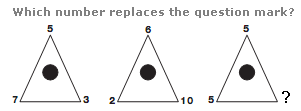
In each triangle, the number at the apex of the triangle equals the average of the two numbers at the bottom.
Explanation:
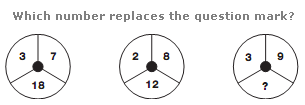
In each circle, the lower number equals the product of the top two numbers, subtracting 3 for the left hand circle, 4 for the middle, and 5 for the right hand circle.

Explanation:
The inner digit in each segment equals the sum of the two numbers in the outer part of the opposite segment.

Explanation:
In each H shape, the central number is equal to the difference between the sum of the 3 left hand numbers and the sum of the 3 right hand numbers.

Explanation:
Reading each row of the diagram as a series of 3 digit numbers, the centre 3 digit number equals the sum of the top 2 numbers, and the sum of the lower 2 numbers.

Explanation:
Start with the top left hand box, and move around the others in a clockwise spiral towards the centre. Read each box as a pair of 2 digit numbers, one above the other. The sum of the 2 digit numbers in each box follows the sequence 55, 60, 65, 70 and 75.

Explanation:
In each group of circles, the centre number equals the average of the four surrounding numbers.
Explanation:
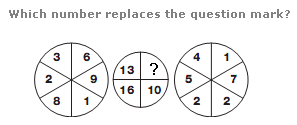
Split the left and right hand circles in half, vertically. The sum of the numbers in the left hand half of the left circle appears in the top left hand segment of the middle circle, and the sum of the numbers in the right hand half of the left hand circle appears in the bottom left hand segment of the middle circle. Repeat this pattern for the right hand circle.

Explanation:
In each diagram, the sum of the upper left and upper middle numbers is written in the centre box, and the sum of the upper right and upper middle numbers is written in the lower central box.

Explanation:
The number at the centre of each segment equals the sum of the numbers on the outside of the opposite segment.

Explanation:
Looking at the diagram as two columns, numbers in the left hand column increase by 5, 6, 7 etc, and numbers in the right hand column increase by 6, 7, 8 etc.

Explanation:
The diagram represents a multiplication sum : 128 x 2 = 256.

Explanation:
Moving from left to right, numbers follow the sequence of square numbers, from 6 to 10, subtracting 4 each time.

Explanation:
Reading each pair of numbers in a row as a 2 digit number, values increase by 6 each time.

Explanation:
Reading each column as a 3 digit number, moving from left to right, the columns follow the sequence of cube numbers of 5, 6 and 7.

Explanation:
In each star, the central value equals the sum of the upper and lower digits on each star, subtracting the sum of the left and right hand digits.
Explanation:
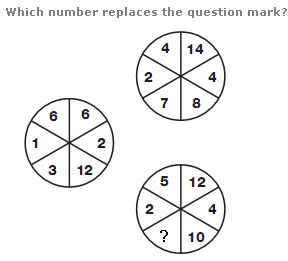
In each circle, double the numbers on the left hand side and put the result in the opposite segment on the right hand side.

Explanation:
In each circle, the number in the lower left segment equals the sum of the numbers in the top two segments, and the number in the lower right circle equals the difference between the numbers in the top two segments.

Explanation:
Working in rows, the sum of numbers in each row follows the sequence 5, 10, 15, 20, 15, 10, 5.

Explanation:
Working from left to right, the sum of the two smaller numbers on each triangle equals the third number.

Explanation:
The number in the centre of each star equals the average of the surrounding 5 numbers.

Explanation:
In each triangle, multiply the lower two numbers together and add the upper number to give the value at the centre.

Explanation:
The numbers on the points of the lower triangle equal the sum of the numbers on corresponding points of the upper two triangles.
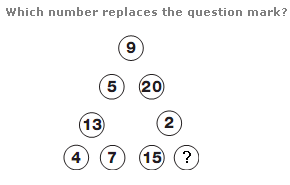
Explanation:
Taking any side of the triangle, the sum of the two corner digits is written in one of the circles on that side, and the difference is written in the other circle.

Explanation:
Reading each horizontal line as a 4 digit number, add together the top two rows to give the result in the third row, and subtract the first row number from the second to give the result in the fourth row.

Explanation:
In each row, the sum of the digits is 10.

Explanation:
Each number represents the numerical value of the vowels in the alphabet.

Explanation:
Moving clockwise around the chain, numbers increase by 4, then 3, then 2, before repeating this pattern.

Explanation:
Starting in the top left and moving in a Z shape around the diagram, each number equals the sum of the previous 2 numbers.

Explanation:
Starting with the bottom line of the triangle and moving up, the sum of the digits in each line decreases by 5 each time, from 20 to 5.

Explanation:
Starting at the top left and working down, then to the right and up, and finally to the right and down in a zig-zag shape, numbers follow the repeated sequence, subtracting 1 then adding 3 etc.

Explanation:
In each segment of the circle, multiply the outer 2 numbers together and subtract the sum of the outer 2 numbers in the opposite segment to give the value in the inner grey segment.

Explanation:
In each diagram, the sum of the three upper numbers equals the product of the two lower numbers.

Explanation:
The diagram contains two diamonds of 3x3 circles, arranged side by side, with the central 4 circles overlapping. Starting in the central left circle of each diamond, the numbers from 1 to 9 are written in lines, moving up and to the right. In the circles where the diamonds overlap, the values are added together to give the ones shown on the final diagram.

Explanation:
Add up the four outer numbers and place your answer in the centre square of the shape one place clockwise.

Explanation:
Taking any series of 3 numbers in a straight line in the diagram, their total is always 19.

Explanation:
Working from the top row, add the values in adjacent boxes and put this sum in the box directly below, working towards the centre. Repeat this pattern starting at the bottom row as well.

Explanation:
Working in rows, from top to bottom, the sum of the digits in each row increases by 2 each time, from 8 to 16.

Explanation:
Working clockwise around the 3 triangles, the sum of the outer digits in each triangle is written in the centre of the triangle one place clockwise.

Explanation:
Numbers follow the sequence of Square Numbers, from 1 to 6, multiplying each one by 2.

Explanation:
As you move down, multiply each number by 2 and subtract 4.

Explanation:
The sum of the numbers along each side of the triangle is always 15.

Explanation:
As you move downwards, numbers increase by 3, then 2, then 1, before repeating this pattern.

Explanation:
The numbers in each row of the diagram add up to 18.

Explanation:
The sum of the 4 digits at the corners of the diagram is 17, as is the sum of the 4 digits in the middle of each side of the diagram.

Explanation:
Starting with the top left square, and moving clockwise around the other 3, the sum of the digits in each square follows the sequence 20, 19, 18, 17.

Explanation:
As you move clockwise around the diagram, add the previous 2 numbers together and subtract 3 to give the next number in the chain.

Explanation:
Starting with the numbers in the top row, and following straight lines through the centre of the diagram, subtract 3 from the number and put the result in the corresponding lower circle.

Explanation:
Reading the top and bottom lines as 2 digit numbers, multiply these together to give the 3 digit result, written in the middle.

Explanation:
Numbers in the segments of the lower left circle equal the sum of the digits in corresponding segments of the upper circles. Numbers in the lower right circle equal the difference between numbers in corresponding segments of the upper circles.

Explanation:
Starting at the top left and moving down, then to the right and up, in a snakes and ladders pattern, add the first two numbers together and subtract 1 to get the next in the sequence.

Explanation:
Divide the whole diagram into 4 equal quarters, each comprising of a 3x3 square. The sequence of numbers in the top left quarter is repeated in each of the other quarters, but increasing by 1 each time as you move clockwise.

Explanation:
In each row of the diagram, the sum of the left and right hand digits, minus the central digit is always 8.

Explanation:
Divide the circle, horizontally and vertically, to give 4 quarters. The sum of the numbers in the segments of each quarter equals 11.

Explanation:
Working through the diagram in rows, and reading each row as a whole number, the diagram represents a subtraction sum : 203 - 7 = 196

Explanation:
Moving from left to right, add 6 to the first number to get the next one along, then 8, 10 and 12 to complete the sequence.

Explanation:
Starting with the top left number, and working down one row at a time, alternating between left and right, double the number each time. Repeat this sequence, starting with the top right number.

Explanation:
Numbers in segments of the central circle equal the difference between the sum of the numbers in corresponding segments of the left two and right two circles.

Explanation:
Working in columns, starting with the top number, add 4 to give the next value down, and add 5 to give the one under that.

Explanation:
In each star, add together the top 3 numbers, and subtract the lower 2 numbers, to give the value in the centre of each star.

Explanation:
In each row of the diagram, add the left and right hand digits together and add 2 to give the result in the centre.

Explanation:
Starting at the top, double each number and add 7 to give the next number down.

Explanation:
Starting at the top on the left, and working in rows across the 3 triangles, values increase by 2, then 3, then 4 etc.

Explanation:
In each star, the average of the outer 3 numbers is written in the centre of the star.

Explanation:
In each triangle, add the lower 2 digits together and multiply by the upper digit to give the result in the centre.

Explanation:
In each circle, add together the numbers in the left and right hand segments, and subtract 2 to give the result in the lower segment.

Explanation:
Working from left to right and reading each pair of numbers as a 2 digit value, these values represent the sequence of multiples of 7, starting at 49 and finishing on 70.

Explanation:
Work through the diagram in columns. The value in the centre of each column equals the difference between the sum of the top 2 numbers and the bottom two numbers.

Explanation:
In each slice of the circle, the difference between the outer and middle numbers is written in the inner segment of the opposite slice.

Explanation:
Calculate the difference between adjacent numbers in the centre of each oval and put the result in the space between the two ovals in the opposite side of the diagram.

Explanation:
In each diagram, the central value equals the difference between the sums of the numbers in the left hand column and the sums of the numbers in the right hand column.

Explanation:
In each diagram, the number at the top equals the average of the four smaller numbers.

Explanation:
In each triangular group of circles, start with the longest row and add together 3 adjacent values and put this sum in the circle directly above or below the centre of the 3 values. Continue this sequence towards the apex of each triangle.

Explanation:
Calculating the sum of the 3 numbers in each row, from top to bottom, the rows follow the sequence of 11, 13, 15 etc.

Explanation:
Start with the row of 4 numbers in the centre of the diagram, and add adjacent pairs of numbers together, putting the results in the circles directly above. Repeat this pattern for the next row up. Next, calculate the difference between adjacent numbers in the middle row, putting the results in the circles directly below. Repeat this pattern for the next row down.

Explanation:
Start with the numbers along the top right diagonal of the diagram, and add pairs of adjacent numbers together, putting the result in the square to the lower left of the original pair of numbers. Continue in this way towards the lower left-hand corner.

Explanation:
Taking numbers in diagonally opposite squares, calculate their sum, and put the answer in the small, inner square of the upper number. Calculate their difference, and put this answer in the small, inner square of the lower number.

Explanation:
Taking the top 3 numbers, add them together, and write the 2 digit result in the spaces below. Repeat this pattern for the next set of numbers.

Explanation:
Working from left to right, numbers represent the reverse alphabetical values of the vowels in the alphabet.

Explanation:
Working from top to bottom, and reading each pair of boxes as a 2 digit number, add 10 to the first number to give the next one down, then add 15, and 20 to complete the sequence.

Explanation:
Working in rows, the central value equals the difference between the left and right-hand values.

Explanation:
Starting on the top left, and moving clockwise around the diagram, add the first two values together to give the next value along. Repeat this sequence.

Explanation:
For each star, add the outer numbers together and divide by 3 for the left hand, 4 for the centre, and 5 for the right hand, putting the result in the centre.

Explanation:
Add together numbers in corresponding segments of the upper two and lower left circles to give the values in corresponding segments of the lower right circle.

Explanation:
In each triangle, add together the lower two digits and subtract 2 for the left hand triangle, 3 for the middle and 4 for the right hand triangle, putting the result at the apex of the triangle.

Explanation:
Add together the four outer numbers in each diagram. Divide this answer by two to get the middle number.

Explanation:
In each triangle, the central value equals the average of the 3 values around the outside.

Explanation:
In each circle, multiply the top two numbers together, and divide by 2 for the left hand circle, 3 for the centre, and 4 for the right hand circle, putting the result in the lower segment.

Explanation:
In each triangle, add together the lower 2 digits, and multiply this by the top digit, to give the value written in the centre of the triangle.
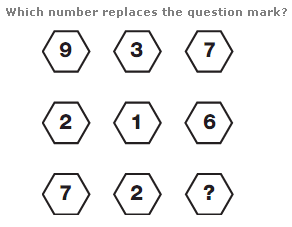
Explanation:
Working in columns, start with the top number, and subtract the number in the centre, to give the result in the bottom row.

Explanation:
Working in rows, from top to bottom, and reading each row as a 4 digit number, rows follow the sequence of Cube Numbers, from 13 to 16.

Explanation:
Starting in the top left and working in columns, add the first two numbers together and add 1 to give the number at the bottom of each row.

Explanation:
The four numbers in the corners of the square, and the four numbers in the middle of each side of the square add up to 21.

Explanation:
Add up numbers in corresponding segments of each square. The sum of the digits in the left hand segments equals 20, the sum of the upper segments equals 22, the right hand segments equals 24 and the lower segments equal 26.

Explanation:
There are two repeated sequences in the circle. Starting with the first segment and moving clockwise, add 1 to the first number, then 2, 3, and 4, writing the results in alternate segments. Starting with the second segment, add 3 to this number, then 4, 5 and 6, writing these results in the alternate segments left.

Explanation:
Reading each row as a whole number, multiply the top 2 digit number by the lower 2 digit number to give the result represented by the middle 3 digit number.

Explanation:
Numbers in boxes from the second row up equal the average of the 2 numbers in the boxes directly below. Continue to the apex of the triangle.

Explanation:
Reading each line of the diagram as a 3 digit number, add the top and middle lines together to give the result on the bottom line.

Explanation:
In each row, add the left and right-hand numbers together and subtract 2 to give the number in the centre of the row.

Explanation:
Working through the diagram in columns, the value at the bottom of each column equals the sum of the top 2 numbers, minus the sum of the next 2 numbers.

Explanation:
In each star, the value at the center equals the difference between the sum of the top 3 numbers and the sum of the bottom 3 numbers.

Explanation:
In each diagram, read the upper and lower pairs of numbers as 2 digit values and add these together to give the result written at the top.

Explanation:
Working in rows, add the left and right hand values together and subtract 3 to give the number in the center of each row.

Explanation:
Add together the four outer numbers of each grid. This answer is the central number of the grid one place further clockwise.

Explanation:
Working in columns, the sum of the numbers in each column equals 23.

Explanation:
Add together numbers in corresponding segments of the outer four squares. The answer is placed in the diagonally opposite segment of the middle square.

Explanation:
Split the diagram into 2 halves vertically, each 3 columns wide. Numbers in the left hand half follow the sequence of cubed numbers, from 64 to 729, and numbers in the right hand half follow the sequence of squared numbers, from 121 to 256.

Explanation:
In each diagram, the central value equals the sum of the left and right hand digits, minus the sum of the upper and lower digits.

Explanation:
In each shape, use the left and right hand numbers as a source. The upper central number equals the sum of the left and right hand numbers, the middle central number equals the product of the left and right hand numbers, and the lower central number equals the difference between the left and right hand numbers.

Explanation:
Working in rows, in each row the central number is equal to the difference between the sum of the even numbers in the row and the sum of the odd numbers in the row.

Explanation:
Starting with the top left segment, and moving clockwise around the circle, numbers follow the sequence of square numbers, from 121 to 256.

Explanation:
Splitting the diagram into 3 smaller triangles, with 3 circles each, the sum of the numbers in each smaller triangle is always 21.

Explanation:
As you work down the column, numbers follow the sequence of Square Numbers from 16 to 81, subtracting 4, then 8, then 12 etc.

Explanation:
Starting at the top and working down, double each number and subtract 5 to give the next number down.

Explanation:
Working in columns, the sum of the numbers in each column equals 18.

Explanation:
Starting on the top left, and moving clockwise in a spiral towards the centre, numbers increase by 7, then decrease by 2. Repeat this pattern all the way around.

Explanation:
Working from left to right numbers follow the sequence of Prime Numbers, subtracting 1 each time.

Explanation:
Working clockwise around the diagram, add the first two numbers together and subtract 3 to give the next number along.

Explanation:
In each circle, the sum of the numbers in the left hand half of the circle equals double that of the numbers in the right hand half of the circle.

Explanation:

Explanation:
Working in rows, top to bottom, reading each row as a 3 digit number, rows follow the sequence of Square Numbers from 11 to 13.

Explanation:
In each row, add together the left and right hand numbers, then add 2 to give the central value.

Explanation:
Start with 1 and move clockwise. Multiply the previous number by 2 and add 4 to give the next number around.

Explanation:
In every row of the diagram, if you subtract the odd numbers from the even number, you always get 10.

Explanation:
In each star, the number in the centre equals the difference between the sum of the even numbers and the sum of the odd numbers around the points of the star.

Explanation:
Starting on the top left and moving to the right, then down one row and to the left, then down to the bottom row and to the right, numbers alternately add 8 then subtract 3.

Explanation:
Take pairs of numbers at opposite ends of the diagram. Their total is always 10.

Explanation:
In each triangle, the central value equals the sum of the 2 even numbers from the outside corners of the triangle minus the odd number.

Explanation:
Start at the top of each triangle and move clockwise around its points. Add the first two numbers together and subtract 2 to give the next value round.

Explanation:
In each triangle, multiply the lower 2 numbers together and subtract the upper number to give the value in the centre.

Explanation:
For each circle, add the left and right hand numbers together and put this total in the circle one place to the right.

Explanation:
Multiply numbers in adjacent circles together, then subtract the original numbers, to give the value in the space in-between.

Explanation:
In each star, calculate the difference between the 2 left hand and 2 right hand numbers. The value at the top of each star equals the product of these differences, and the value at the bottom of each star equals the difference between these 2 differences.

Explanation:
In each figure, calculate the difference between the upper and lower left hand numbers, and the upper and lower right hand numbers and multiply these differences together to give the value at the top.

Explanation:
Working from top to bottom, and reading each row as a 3 digit number, rows are arranged in order of the Square Numbers, from 11 to 15, with the digits reversed in each case.

Explanation:
Work through the diagram in horizontal rows. The sum of the numbers in each row is always 23.

Explanation:
Take values in corresponding positions of the outer 4 shapes, and put the results in the central shape, rotating the position of this result by 1/4 turn each time.

Explanation:
Calculate the sum of the numbers in corresponding positions of the outer 4 squares, subtract 5 form this result, and put it in the corresponding position of the middle square, 1/4 turn anticlockwise from the original.

Explanation:
Working from top to bottom, reading each pair of numbers as a 2 digit value, values represent the reverse alphabetical value of letters of the alphabet, starting with A, written with 3 straight lines only.

Explanation:
Starting with the circle on the top left, and moving to the right, top row then bottom row, the sum of the numbers in each circle follows the sequence 12, 15, 18, 21 etc.

Explanation:
Split the whole diagram in half, horizontally, to give two groups of 5 octagons. In each group, the central number in the top row equals the sum of the surrounding 4 numbers.

Explanation:
Starting on the left and moving right, double each number and add 2 to give the next number along.

Explanation:
Reading each pair of numbers as 2 digit values, the sum of the 4 numbers is given in the top space in the diagram.

Explanation:
In each circle, the number in the lower segment equals twice the difference between the numbers in the left and right hand segments.

Explanation:
Working through the diagram in rows, add the left and central numbers together and subtract 2 to give the right hand value.

Explanation:
Reading each row as a 3 or 2 digit number, subtract the central 2 digit value from the upper 3 digit value, to give the 3 digit result on the lower row.

Explanation:
Starting with the left hand circle, add 4 to each number and rotate their positions 1 place clockwise to give the values in the upper right hand circle, then add 5 to each of these values and rotate their positions 1 place clockwise to give the values in the lower right hand circle.

Explanation:
Working in columns, divide the top value by 2 to give the middle value, and multiply this by 3 to give the bottom value.

Explanation:
On each row of the diagram, the value in the centre of each row equals the sum of the other numbers in the row, subtracting 2.

Explanation:
In each diagram, the sum of the top two and middle digits equals the sum of the lower 2 digits.

Explanation:
In each circle, add together the left and right hand digits, and add 3 to give the value of the lower digit.

Explanation:
tart with the top left circle, and move around the others in a W shape. The sum of the numbers in each circle follows the sequence of 10, 12, 14, 16 and 18.

Explanation:
In each triangle, add up the lower 3 digits and divide by 3 to give the value at the apex of the triangle.

Explanation:
Starting with the lowest number and moving clockwise, add the separate digits of the first number together and add this to the original number, writing the result in the next segment along.

Explanation:
Add the first two numbers together and then subtract 4 to give the next number along.

Explanation:
Working in rows, from left to right, double the left hand number to get the middle number, and add 3 to this to get the right hand number.

Explanation:
Split the diagram into two halves vertically, consisting of 2 columns of 2 squares each, and read each 2 adjoining squares as a complete 2 digit number. Numbers follow the sequence of multiples of 7, subtracting 1 each time.

Explanation:
Working through the diagram in columns, add 4 to the top number to give the middle one, and add 6 to this number to give the lowest one.

Explanation:
Working in rows, starting with the central row, add the left and right hand digits together and put the result in the central space. Repeat for the upper and lower rows, but put the result in the opposite central space.

Explanation:
Starting on the left, halve the first number and add it to the second number to give the next one along. Repeat this sequence all the way to the right.

Explanation:
As you move down, numbers represent the reverse alphabetical values of the 5 vowels.

Explanation:
Starting with the top segment, and moving clockwise, add the numbers in the first two segments together and subtract 7 to give the next number around.

Explanation:
Starting with the numbers in the top row, left to right, multiply each one by 2 and write the results in the lower row, from right to left.

Explanation:
Starting with numbers on the bottom row, add numbers in adjacent boxes together, and put the result in the box directly above. Continue in this way, up the triangle.

Explanation:
Reading each row as a 4 digit number, from top to bottom, rows follow the sequence of Cube Numbers from 16 to 19.

Explanation:
Split the diagram into 3 columns, each 2 spaces wide, and read each double space as a 2 digit number. Starting at the top of each column, add the 2 separate digits together, then add this to the whole 2 digit number, to give the result, written in the spaces underneath.

Explanation:
Working through the diagram in rows, find the difference between the left and right hand values, then add 2 to give the value in the central space.

Explanation:
In each square, multiply the top and bottom numbers together to give a 2 digit result, and write this result in the left and right hand spaces.

Explanation:
Working through the diagram in rows, the central value equals the sum of the other numbers in the row.

Explanation:
Multiply the 2 numbers in the outer segments together and add 1 to give the value in the inner segment opposite.

Explanation:
In each star, the number in the centre equals the difference between the sum of the numbers in the upwards triangle and the sum of the numbers in the downward triangle.

Explanation:
In each diagram, multiply the numbers shown on the arms together and add the number at the very top to give a 2 digit result, written in the lower 2 spaces.

Explanation:
Use the top two diagrams as a source. Numbers in corresponding positions in the lower left diagram equal the sums of the numbers in the top two diagrams, numbers in the central diagram equal their product, and numbers in the lower right diagram equal their difference.

Explanation:
The average of the numbers in each column is always 4.

Explanation:
Using the top two grids as a source, numbers in the lower left grid equal the sums of numbers in corresponding positions of the top two grids, subtracting 1 each time, and numbers in the lower right grid equal the differences between numbers in corresponding positions of the top two grids, adding 1 each time.

Explanation:
Take any group of 5 numbers along the side of the square, and their total is always 25.

Explanation:
In each diagram, add up the 4 outer numbers then add 2 for the left hand group, 4 for the next, then 6, then 8, and put this result in the central circle.

Explanation:
Calculate the sums of the numbers in the left and right hand circles, to give 2 digit answers. Write the left hand answer in the top 2 segments of the central circle, and put the right hand answer in the bottom 2 segments of the central circle.

Explanation:
In each diagram, multiply the left hand number by the upper central number to give the central number one line down, and multiply the right hand number by the upper central number to give the lower central number.

Explanation:
Split the circle in half vertically, and take pairs of digits from corresponding segments of the left and right hand halves of the circle. Reading these pairs of digits as 2 digit numbers, these numbers follow the sequence of multiples of 9, from 45 to 63.

Explanation:
In each row, the middle value equals the sum of the left and right hand values, adding 2 for the top row, 4 for the middle row, and 6 for the bottom row.

Explanation:
Working through the diagram in rows, the right hand value equals the sum of any odd numbers in the rest of the row.
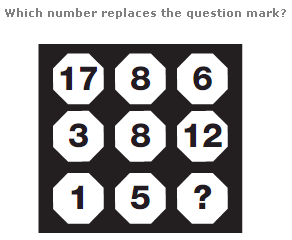
Explanation:
The sum of the numbers in each column of the diagram is always 21.

Explanation:
Add the number at each corner of the diagram to its 2 adjacent numbers. The total is always 15.

Explanation:
As you move clockwise, subtract 3 from the first number and multiply by 2 to give the next one round.

Explanation:
As you move to the right, double the first number to give the next one, then subtract 5. Repeat this sequence.

Explanation:
Numbers in the segments of the upper left hand circle equal the product of the numbers in corresponding segments of the lower 2 circles, and the numbers in the segments of the upper right hand circle equal the sum of the numbers in corresponding segments of the bottom two circles.

Explanation:
Working from the bottom row to the apex of the triangle, the sum of the values in each row follows the sequence 15, 14, 13,12.

Explanation:
Each row and column of the diagram adds up to 15.

Explanation:
From top to bottom, reading each pair of numbers as a 2 digit value, the numbers follow the sequence of square numbers, from 16 to 49, each written back to front.

Explanation:
Split the diagram into 3 vertical columns. The sum of the numbers in each column equal 17.

Explanation:
As you move to the right, double the previous number and subtract 4, then 3, then 2, then 1 to give the next number along.

Explanation:
Start anywhere on the diagram, and move clockwise, calculating the sum of every third circle. This always equals 15.

Explanation:
In each column of the diagram, the central value equals the average of the upper and lower numbers.
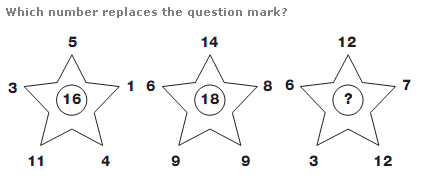
Explanation:
In each star, the central value equals the sum of the top and lower two numbers, minus the left and right hand numbers.

Explanation:
Read each row of 3 numbers as a 3 digit number, and add the top row value to the middle row, to give the result written in the bottom row.

Explanation:
In each row, add the left and central numbers together, double it and add 1 to give the right hand value.

Explanation:
Starting at the top, add the left and right hand numbers together and subtract 5 to give the lower left number. Add 2 to the left hand number to give the lower right hand number.

Explanation:
In each triangle, the central value equals the product of the 3 outer numbers subtracting the sum of the 3 outer numbers.

Explanation:
In each triangle, multiply the lower two numbers together and add the upper number to give the value in the centre.